
Blog
Retatrutide Phase 3 Results: What the TRIUMPH-2 Trial Means for Canada

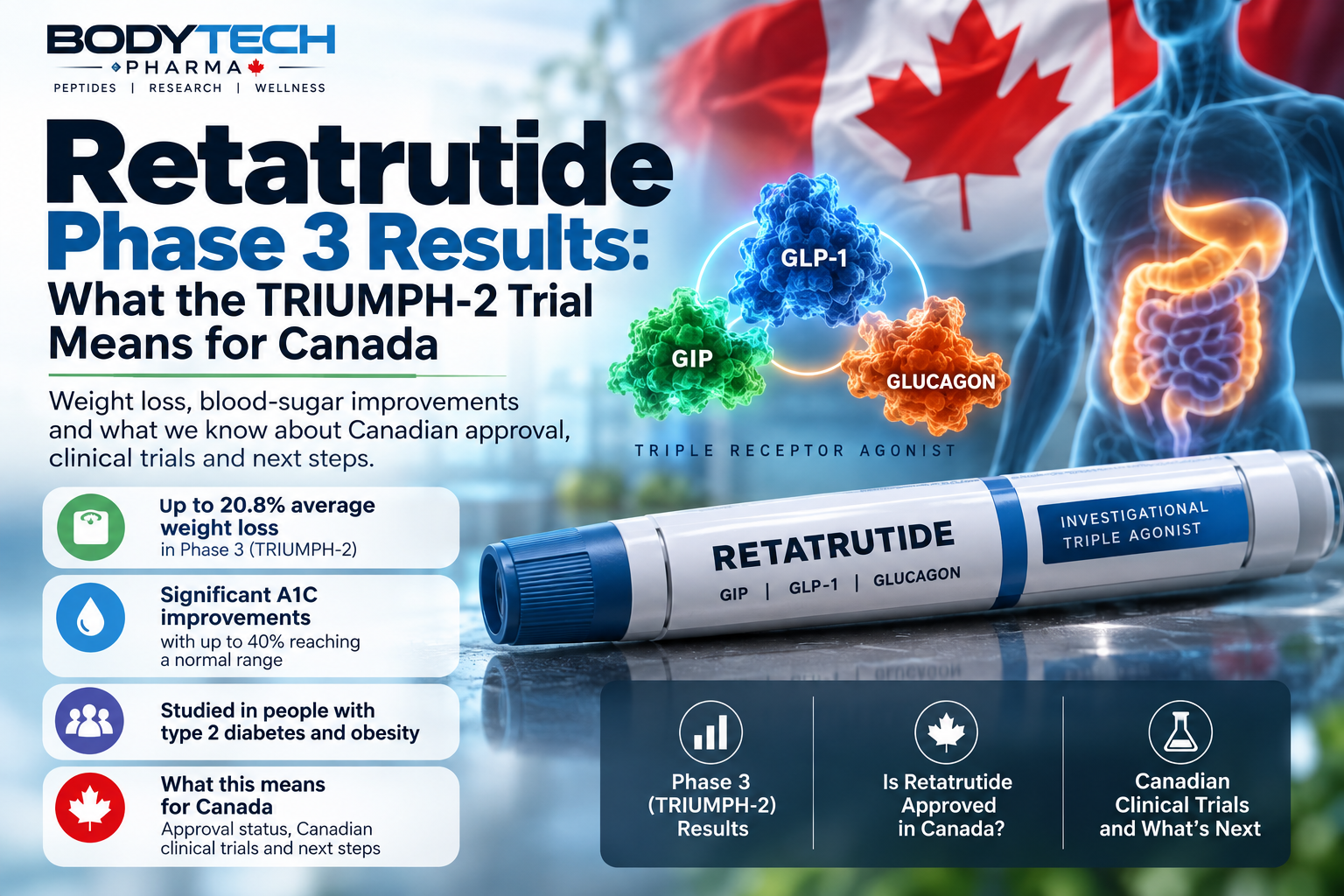
Retatrutide Phase 3 results are providing a clearer picture of the investigational triple hormone receptor agonist’s potential effects on body weight and blood-sugar control. New TRIUMPH-2 data reported in September 2026 evaluated retatrutide in adults with type 2 diabetes and obesity or overweight.
For Canadians following this research, there is also an important regulatory distinction: retatrutide is being studied in Canadian clinical trials, but it is not approved by Health Canada for routine human use.
Is Retatrutide Approved in Canada?
No. As of October 2026, retatrutide remains investigational and is not approved by Health Canada for routine clinical use. Lilly Canada has stated that retatrutide has not been approved for human use by Health Canada or any other regulatory agency.
Health Canada’s clinical-trial portal does list authorized Canadian studies involving retatrutide. Authorization to conduct a clinical trial, however, is not the same as authorization to market or sell a drug for routine use.
What Is Retatrutide?
Retatrutide (LY3437943) is an investigational once-weekly molecule designed to activate three hormone receptors: glucose-dependent insulinotropic polypeptide (GIP), glucagon-like peptide-1 (GLP-1), and glucagon. This three-receptor mechanism is why it is described as a triple hormone receptor agonist.
Retatrutide Phase 3 Results: TRIUMPH-2
TRIUMPH-2 was a randomized, double-blind, placebo-controlled Phase 3 trial involving 1,152 adults with type 2 diabetes and obesity or overweight. Participants were randomized to retatrutide 4 mg, 9 mg, 12 mg, or placebo, with the primary efficacy assessment at 80 weeks.
How Much Weight Did Participants Lose?
- 4 mg: average body-weight change of -12.7%
- 9 mg: -19.1%
- 12 mg: -20.8%
- Placebo: -4.0%
At 12 mg, the reported average reduction was 49.6 lb (22.5 kg). Among participants starting with a BMI of at least 35 kg/m², the average reduction at 12 mg was 23.4%.
How Many Participants Lost 20% or More?
At 80 weeks, 24.0% of participants receiving 4 mg, 45.3% receiving 9 mg and 52.0% receiving 12 mg achieved at least 20% body-weight reduction, compared with 1.5% receiving placebo. At 12 mg, 34.9% achieved at least 25% body-weight reduction.
What Happened to A1C?
Participants began with an average A1C of 7.7%. Average A1C changes were -1.4 percentage points with 4 mg, -1.6 with 9 mg, -1.5 with 12 mg and -0.2 with placebo. Up to 40.0% of participants receiving retatrutide reached an A1C below 5.7% during the trial.
These results describe glycemic control during a clinical trial and should not be interpreted as evidence that retatrutide cures diabetes.
Retatrutide Safety and Study Limitations
The most common adverse events reported in TRIUMPH-2 were gastrointestinal. At 12 mg, diarrhea was reported in 33.6%, nausea in 28.0%, constipation in 16.8% and vomiting in 15.7% of participants. Discontinuation due to adverse events occurred in 7.7% of the 12 mg group versus 4.9% with placebo.
Retatrutide remains investigational. Controlled clinical-trial results do not guarantee the same outcome for an individual, and longer-term evidence is needed to understand durability, longer-term safety and outcomes after treatment discontinuation. Comparisons with semaglutide, tirzepatide or other therapies should ideally come from head-to-head trials rather than comparing percentages from unrelated studies.
Retatrutide Clinical Trials in Canada
Canada is participating in the broader retatrutide clinical-development program. Health Canada’s Canadian Clinical Trial Search Portal lists Phase 3 and Phase 3b research, including TRIUMPH-6 for maintenance of weight reduction, TRIUMPH-7 in obesity or overweight with chronic low-back pain, TRIUMPH-Outcomes examining cardiovascular and kidney outcomes, and TRANSCEND-T2D-2 comparing retatrutide with semaglutide in adults with type 2 diabetes.
Again, Canadian authorization of these trials means Health Canada determined that the trial could proceed under its clinical-trial requirements; it does not mean retatrutide is approved for sale or routine prescribing.
Frequently Asked Questions
Is retatrutide approved in Canada?
No. As of October 2026, retatrutide remains investigational and is not approved by Health Canada for routine human use.
What were the Retatrutide Phase 3 weight-loss results?
In TRIUMPH-2, the 12 mg group had an average body-weight reduction of 20.8% at 80 weeks, compared with 4.0% with placebo.
Is retatrutide a GLP-1 drug?
Retatrutide includes GLP-1 receptor activity, but it is more accurately described as an investigational triple agonist because it activates GIP, GLP-1 and glucagon receptors.
Is retatrutide the same as tirzepatide?
No. Tirzepatide targets GIP and GLP-1 receptors, while retatrutide is designed to target GIP, GLP-1 and glucagon receptors.
Are there retatrutide clinical trials in Canada?
Yes. Health Canada’s clinical-trial portal lists multiple Canadian retatrutide studies. Clinical-trial authorization is different from approval for commercial sale or routine medical use.
The Bottom Line
The latest retatrutide Phase 3 results add substantial new evidence to the clinical-development program. In TRIUMPH-2, adults with type 2 diabetes and obesity or overweight experienced significant average reductions in body weight and A1C during 80 weeks of treatment.
For people searching for retatrutide in Canada, the regulatory distinction remains essential: retatrutide is still investigational and is not currently approved by Health Canada for routine human use.
Sources
- Eli Lilly — TRIUMPH-2 Phase 3 results, September 29, 2026
- Lilly Canada — Retatrutide Canadian public-safety notice
- Health Canada — TRIUMPH-6 Canadian clinical-trial record
This article is for educational and research-information purposes and does not constitute medical advice.